
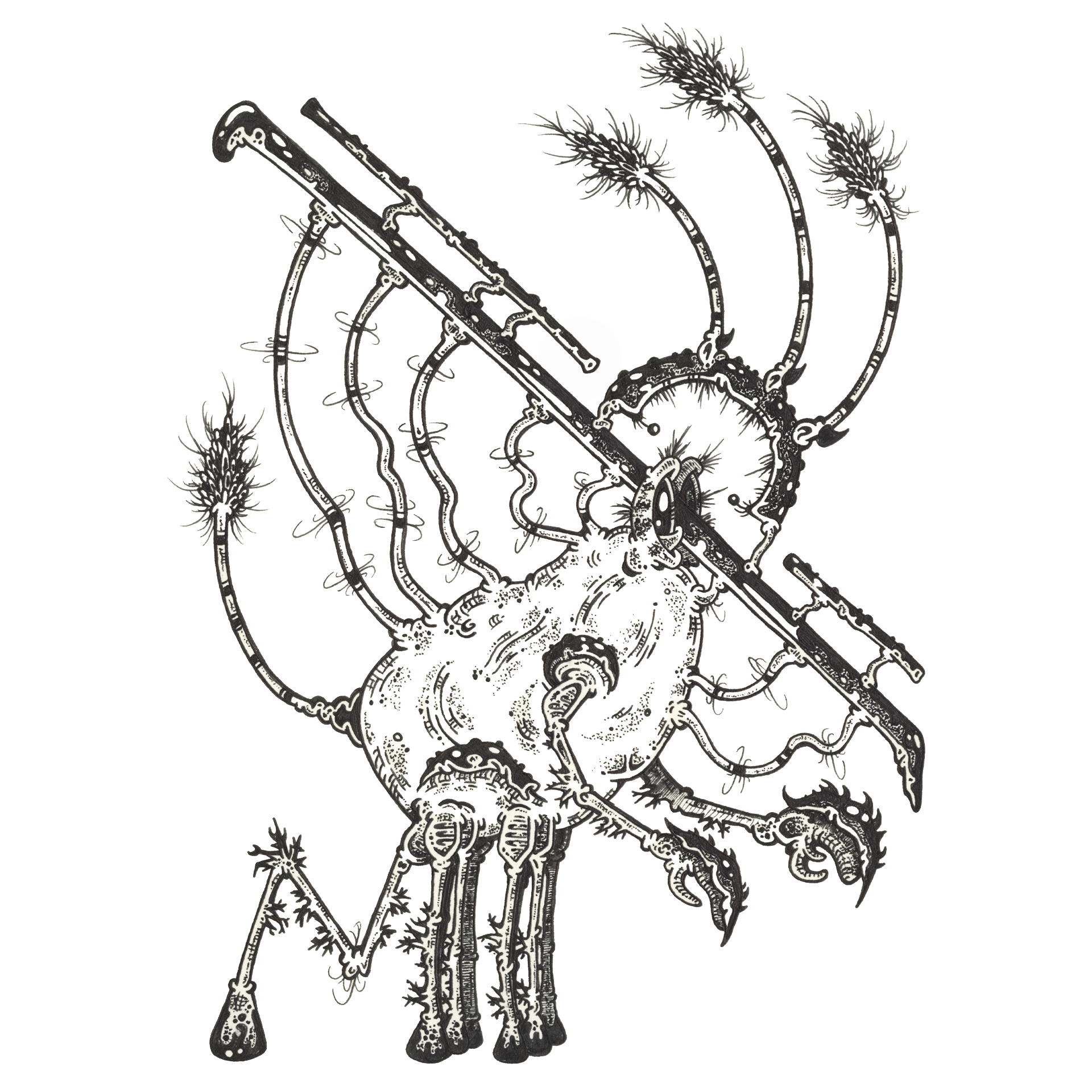

Clickety clack, clickety clack, clickety clack clack goes the desert-dwelling ZizzenBree. A voiceless sandivore (filters food through sand) that trudges ever so carefully through the deserts of their home planet, ZamynPrue. They are a remarkably tall species, with some varieties reaching a height of 10 to 20 Earthen feet high. They possess some very unique, but effective, traits to help them gather food, scare away predators, attract mates, and defend themselves if need be.
They possess 11 unique padded, spongy feet, which are perfect for keeping them balanced on the sands of their home and for leaving as small a set of footprints as possible so predators do not track them. Their 11th foot is exceedingly specialized, as it has an extra joint, a larger surface area, and is used to wipe away their original tracks as a secondary defense mechanism.
On top of that, they have two front-facing armored claws. These are primarily used to dig into the ground to loosen up sand and crack open various plants and hard-shelled nuts that they are lucky to find in their rather barren home. But if need be, and if they come across a predator or a rival, they can use them for deadly close combat. You would certainly not want to get in the way of these ambidextrous and exceedingly sharp claws.
As you gaze up across their body, you’ll see two very large and mournful eyes that stick out and are always scanning the surface for whatever and whoever they can find. Additionally, they have four bristled antennae that they use to search for water and moisture on the winds. Not only can these locate sources of water, but in extreme cases, they can actually create dew at night as the temperatures fall to help meet the water needs of these remarkable creatures.
Now, their most remarkable feature has to be the long, body-spanning bony protrusions that are held aloft by the secondary set of tentacles that erupt from their dorsal and ventral surfaces. These protrusions are as hard as rock and are used for two main purposes. The first is that they will stick them in the ground to help filter out the microscopic creatures from the sand that they primarily consume. Second, as they walk across their sandy desert homes, the secondary tubes will bounce off the main tube, creating a click-clack sound that not only communicates to others of their own kind, but is exceedingly effective in scaring off predators and sentient beings whose mythologies state that these click-clack sounds mean that danger is on its way.
Leave a Reply